About This File
⚡ Zigbee Monitor – A Complete Health Dashboard for Your Zigbee
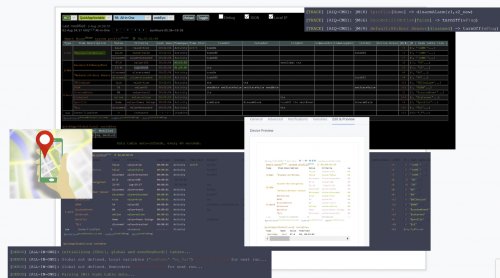
This QuickApp gives you a real‑time, high‑precision diagnostic view of your entire ZigBee network.
It tracks every device, evaluates link quality, detects ZigBee Engine freezes or crashes, highlights weak or unstable nodes, monitors battery health, and records communication drops over time.
Automatic sorting, color‑coded warnings, min/max LQI history, and intelligent ZigBee Engine health scoring, it turns your HC3 into a full ZigBee analytics console—making mesh problems visible instantly instead of guessing in the dark.
📑 Table Columns
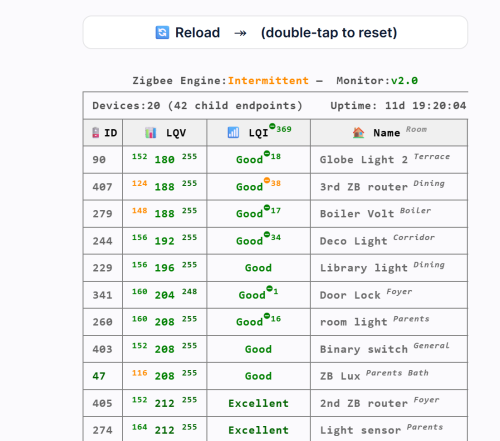
🪫 ID Device ID with battery status. Battery devices show color‑coded percentage; routers show “Serves as Router.” Ghost nodes appear as 👻.
📊 LQV (LQI value) Shows min / current / max LQI values recorded since last reset. Helps identify unstable or fluctuating devices.
📶 LQI (Quality Status) Color‑coded signal quality label: Excellent, Good, Weak, Poor, Critical. Includes drop‑severity superscripts when applicable.
❤️ Alive Displayed only when at least one device is dead. Shows “false” in red for non‑responsive nodes.
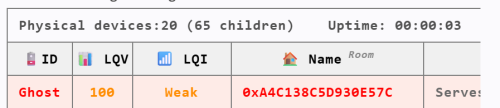
🏠 Name Room Device name with room shown in superscript. Ghost devices show their IEEE address instead.
📦 Type Indicates whether the device is Battery‑Powered (with percentage) or Serves as Router.
🔖 Vendor Manufacturer reported by the ZigBee device.
🔢 Model Device model identifier (e.g., E1743, SNZB‑02).
🧬 Family Routing family chain showing how HC3 child devices relate to each other (e.g., 123👥🡒456🡒789).
Requirements
-
HC3 with ZigBee enabled
-
QuickApp variables: user, password (secured)
User and Password
The QuickApp needs credentials to access the internal ZigBee API through the HC3 proxy.
Enter its username and password in the QA’s Variables tab.
The QA automatically encodes these values and uses them only for read‑only Zigbee queries.
Note: For security, you can create a dedicated HC3 user with limited permissions (not your main admin account)
What It Shows
ZigBee Engine status
ID, LQV (with min/max range), LQI status, Alive (if needed), Name and Room, Type, Vendor, Model, Family.
Please download and review the ZigBee Monitor User’s Guide for further details.
You can also download the ZigBee & HC3 Capacity Planning Guide, which helps you build a more stable and reliable ZigBee network.
Edited by cag014
What's New in Version 2.1 See changelog
Released
📌 Calculation & Stability Logic Updates
-
Added startup grace period to avoid incorrect status during the first minutes after reboot.
-
Balanced disconnect scoring so brief spikes or early reconnects don’t trigger warnings.
-
Weighted router vs. battery devices to prevent small sensor drops from affecting global status.
-
Adjusted thresholds to require consistent issues before marking the engine as degraded.
-
Improved LQI trend handling to reduce false positives from short‑term RF noise.
📘ZigBee & HC3 capacity Planning Guide
This guide explains how to build a stable ZigBee mesh on the HC3. It covers device roles, how parenting works, and why routers—not the coordinator—determine network stability. It highlights that many mains‑powered devices are poor routers, lists models proven to work well, and provides practical rules for how many routers you need. The guide also includes placement tips and common symptoms of weak routing to help diagnose mesh issues quickly.
📥 Installation Instructions
For New Users
If you are installing the QA for the first time:
-
Download
LQI.v2.1.fqa -
Open your HC3 → Settings → Devices → Add Device → Upload File
-
Upload the
LQI.v2.1.fqafile -
🔐 This QuickApp needs access to the HC3 Zigbee API, so you must provide an HC3 username and password in the QA’s Variables tab.
-
Open the QuickApp → Variables tab.
-
Add two variables - you can use Secret option too
-
user → your HC3 username
-
password → the password for that user
-
-
-
The QA will appear automatically and start building the table. This is the full package and includes all required code and configuration.
For Existing Users - If you already have the QA installed, use this to update from an earlier version
If you already have the QA installed:
-
Download
LQI.v2.1.txt -
Open your existing QA on the HC3
-
Replace the current main code with the content of the
.txtfile (copy & paste) -
Save the QA
-
The table will refresh automatically on the next update cycle.